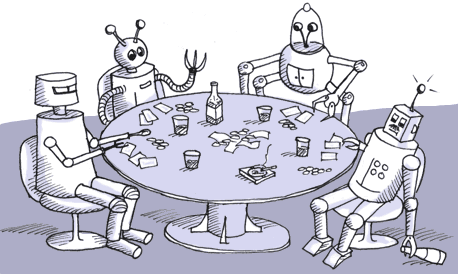
Why Poker-Bots are justifiable - A Painfully Ignorant Point of View
I ran across this article other other day that attempts to justify bot usage and cheating at online poker and I just couldn't resist responding. After getting some feedback on my…
I ran across this article other other day that attempts to justify bot usage and cheating at online poker and I just couldn’t resist responding.
After getting some feedback on my previous article about poker and online gaming cheats I decided to attempt to clarify my thoughts somewhat. What seems most debatable are my reasons for feelig justified in saying it is okay to cheat in online gambling games such as poker but unfair to do so in an online computer or video game like Counterstrike.
So right off the bat, let’s explain this a bit. The author states on his website that he has a degree is philosophy from the University of Leeds. I assume, based on this and another article which I’ll mention shortly that he’s attempting to discuss this issue from a moral or philosophical point of view.
My reasoning for that statement is thus: In my opinion the massive billion dollar industry of online poker is a bloated bubble waiting to burst. As your average consumer becomes more aware that he is potentially facing cheats when sitting down at the virtual card table the industry will struggle to survive. Nobody wants to play poker, risking their hard earned dough, on a game that can and is being easily rigged. Even if the various governments made a futile attempt to ban the use of bots in online gambling games, something they have shown no inclination towards doing thus far, it would make little difference. Detection of the bots would be difficult if not impossible and even if detecting became easier the underlying fear that every time you lose a hand it was because you were in some way cheated would always remain.
But, in his previous article that he references, he makes the following statement:
With competition in online games growing bigger with each and every year, in terms of competitors and prizes the bots that enable these cheats pose a serious problem.
He goes on in such a way that indicates that he’s very familiar with playing video/computer games. He discusses LAN tournaments and such which is a step above someone with a tangental interest in the subject. So, because he like playing video games he recommends serious and strict punishment for cheaters in these online tournaments but then explains why he thinks it’s okay to cheat at online poker. Something tells me that it has to do with the fact that he plays one game but not the other.
He attempts to justify his views by saying that the online poker industry is a bubble waiting to burst. Though I don’t believe this premise to even be true, I guess one could use that line of thinking to say that during the dotcom bubble, stealing, fraud, and other misdeeds should not only have gone unpunished but should have been rewarded. It’s really a very illogical argument. It’s too big so cheating is okay sums up his view.
He also makes the false assumption that bots equal cheating. While it is certainly true that most sites do not want bots playing on their site and most players don’t want to play against bots, the bots in and of themselves are not cheating. They simply play a very basic strategy that any human player could learn with relative ease. Heck, even I learned it :-)
The problem is that people like playing against other players. Playing against a bot, psychologically, feels like you’re playing against a house like you do in online blackjack or video poker. People play poker because there isn’t some pre-determined house edge that will eventually drain their accounts. If you and I sit down at a poker table, in theory, the better player will win. It’s that competition, that desire to be better than your opponent, that makes poker fun. Bots take away some of that thrill. Playing against a bot that plays some set strategy removes a bit of the excitement of winning with a big bluff or trapping your opponent with your flopped set. But, and this should be very clear, the bots aren’t actually cheating (there are exceptions to this but most bots do not share information). The bots are simply diminishing one of the aspects that players enjoy. This is why poker rooms ban them in the same way they ban players that become abusive in the table chat.
The author also states that the detection of bots is difficult if not futile. Again, the author seems to know nothing about the topic. Bots are not that difficult to detect. Party has done such a good job of it that most bot authors don’t even try to write software that can play on their site. The bot authors pick on smaller rooms who may be resource stretched and can’t commit the resources to combat the bots. Of course, it’s a cat and mouse game. If every site used the same methods and software that Party does then the bot authors would spend more time and effort in creating ways to circumvent Party’s anti-bot software. And then Party would improve their anti-bot software and the cycle would continue until it becomes financially prohibitive for one of the parties. And since the poker rooms are protecting a multi-billion dollar business while the bot authors have far fewer zeros in their bank account balance, it’s pretty obvious who will win this struggle.
Does that mean that no bots will ever be able to play? No. Some whiz-kid is going to figure out a way to get his bot in there undetected but the moment he tries to make his program available as a commercial product people like Party will reverse engineer it and figure out what sort of footprint it creates that can be detected and stopped. But, that in itself limits the scope of the problem. In order to get in under the radar the bot author needs to keep things to himself and potentially a small network of trusted friends who won’t abuse it.
It is on that basis that I condone the use of bots – in all likelihood if you are a regular online gambler then you will have come across somebody using one; somebody who has consequently won and taken your money. As Joe Bloggs becomes more aware of the widescale cheating in online gambling the whole deck of cards will topple to the ground rather suddenly. So why not in that time make a little bit of money? The online gaming companies like Party poker and 888 have made an absolute killing in the few years they have existed. They’ve taken your money so why not get your own back a little by contributing to their downfall and be one of the clever ones and set up your own poker-bot.
Well, as I’ve said in many previous discussions on this topic; I have played against bots and I have won. Bots aren’t magical. Bots tend to have exploitable flaws that a good player can detect and take advantage of. Most of the bots I’ve run across are too conservative and unless they’re holding a very, very strong hand can be bluffed off hands that I would have a hard time bluffing a fishy calling station off of.
The other problem I have with the author’s logic is that he seems to not realize that poker is a zero sum game except for the rake. If you had one of these “cheating” bots, you are cheating other human beings. The argument that the online poker sites have made billions as a justification for cheating is akin to saying that it’s okay to hold up people in the McDonald’s parking lot because McDonald’s makes billions of dollars a year off of you and you should be entitled to get some of that money back.
So what’s the difference between running a poker-bot to win money and cheating in Counterstrike? Why do I deem cheating in an online FPS (first person shooter) wrong yet cheating to make money right? To explain my reasons I must draw an analogy:
Imagine a group of children playing hide and seek. All of the children play fairly and cover their eyes whilst the others go hide. One child, when playing the role of the seeker chooses not to do this and decides instead that he will watch secretively. He wins the game every time though only through cheating. There is no reward on offer other than the respect he gains from his pier. Respect gained in this manner means nothing, undermined by the fact it was earned through foul play. In this situation the child who cheats gains nothing of any value or worth.
However if such a game involved money and there was not only a prize of respect on offer but also a financial reward then the whole process is turned on his head. His cheating to win in this situation would still gain him no respect but perhaps could allow for a monetary prize. This is thus a worthwhile objective providing he can get away with it and not jeopardize future opportunities to play the game and gain money. In this scenario the cheating has a practical goal and serves a purpose for the cheat. It is therefore justifiable.
So, let’s say that my co-worker and I are competing for a promotion. If I kill him and thus eliminate him as competition then I will get the promotion by default. Certainly the author must believe that to be justifiable.
I just wish people who have no ethics or morals would just admit they are the bankrupt people they are rather than attempt to justify their views (and actions) with nonsensical arguments like this.
So it can be understood why using poker-bots to cheat has a different moral impact than using cheats in games like Counterstrike, one provides worth and value whilst the other provides nothing positive. Hopefully that clears up everything for those who thought the previous article contained a contradiction.
posted by Ryan Garside @ 7:06 PM
According to Dictionary.com, moral is defined as:
mor·al Audio pronunciation of “moral” ( P ) Pronunciation Key (môrl, mr-) adj.
- Of or concerned with the judgment of the goodness or badness of human action and character: moral scrutiny; a moral quandary.
- Teaching or exhibiting goodness or correctness of character and behavior: a moral lesson.
- Conforming to standards of what is right or just in behavior; virtuous: a moral life.
- Arising from conscience or the sense of right and wrong: a moral obligation.
- Having psychological rather than physical or tangible effects: a moral victory; moral support.
- Based on strong likelihood or firm conviction, rather than on the actual evidence: a moral certainty.
The common thread in all definitions is the idea of right and wrong. And I’m surprised that I need to respond to a philosophy major to remind him that money or financial gain is not the only measure of how right or wrong a decision or action is. Whether one gains financially is of no consequence in terms of moral impact. Cheating is cheating.
I guess there’s also the part where I get a chuckle out of the fact that the author of this piece is a philosophy major and a journalist/writer. Obviously choosing career path that is likely to leave him far from being a wealthy man unless he is one of the rare few who break out and become a brand unto themselves. I find it funny because it’s quite obvious the author didn’t approach the rest of his life with this philosophy of money being the sole driver of decision making and morality.